André Derain Paintings: Life, Style & Famous Works | Zephyeer
André Derain
Paintings
Co-founder of Fauvism, Derain liberated color from description, creating landscapes and figures of explosive chromatic intensity.

Who Was André Derain?
André Derain (1880–1954) was a French painter, sculptor, and co-founder of Fauvism alongside Henri Matisse. Born in Chatou, he met Matisse in 1899 while studying at the Académie Camillo and soon began experimenting with pure, unmodulated color. Along with Maurice de Vlaminck, Derain formed the “Chatou group” that would ignite the radical Fauvist movement—an aesthetic that rejected naturalistic color in favor of emotional, symbolic hues. His early landscapes of the Mediterranean and London series became manifestos of chromatic liberation.
By 1908, Derain’s style shifted: he embraced Cézanne’s structural approach and later delved into a more classical, sober idiom, influenced by early Renaissance art. Despite this turn, his Fauvist works remained foundational to modernism. During World War I, he served in the artillery, and after the war he gained commercial success with portraits, still lifes, and set designs for Diaghilev’s Ballets Russes. Throughout the 1920s and 1930s, Derain’s work oscillated between modernity and tradition, earning him international acclaim.
Derain died in 1954 in Garches, leaving a legacy as a master of color and a key figure in the transition from 19th-century academicism to 20th-century abstraction. His influence reached Georges Braque, Pablo Picasso, and the German Expressionists. Today, his paintings are held in every major museum, from MoMA to the Musée d’Orsay.
Derain’s Fauvist works employed juxtaposed patches of vermilion, emerald, and cobalt—not to describe reality, but to build form through pure chromatic energy, a technique that dismantled Renaissance perspective.
Charing Cross Bridge
Painted during Derain’s explosive Fauvist period, this London cityscape abandons naturalistic tones. The Thames shimmers in orange and pink, the bridge is a slash of cobalt, and the sky bleeds yellow—Derain transforms London fog into a prismatic symphony. Commissioned by dealer Ambroise Vollard, the series reimagines Impressionist motifs through pure color.
Critics were astonished by the painting’s radical non-naturalism; it directly challenged the notion of local color. Derain used thick, directional brushwork to construct architectural forms, merging Van Gogh’s intensity with Matisse’s decorative freedom.
One of the most audacious urban landscapes of the 20th century, it predicted later Color Field painting and remains a benchmark of Fauvist ambition.

The Turning Road, L'Estaque
Derain spent the summer of 1906 in L’Estaque, a fishing village near Marseille. This canvas, bursting with oranges, greens, and reds, shows a winding road cutting through vibrant vegetation. The painting’s kinetic energy comes from its broken brushwork and steep perspective, which flattens the scene into a tapestry of color.
Unlike Cézanne’s structural approach in the same location, Derain prioritizes sensation over geometry. The result is a euphoric celebration of Mediterranean light, prefiguring later Orphism.
Derain applied paint in comma strokes and pure pigments directly from the tube, creating optical vibration without mixing on the palette.

Portrait of Henri Matisse
Derain painted this portrait of his fellow Fauvist leader in 1905, the year of the Salon d’Automne that birthed the movement’s name. Matisse appears with a green-striped beard, orange face, and a yellow cap—an audacious deconstruction of likeness in favor of expressive color.
The painting was considered scandalous but solidified their alliance. It shows Derain’s ability to convey personality through aggressive tonal juxtaposition, a strategy he would later abandon.
This portrait is often cited as a manifesto of Fauvism’s radical break from naturalism, influencing generations of expressionist portraiture.
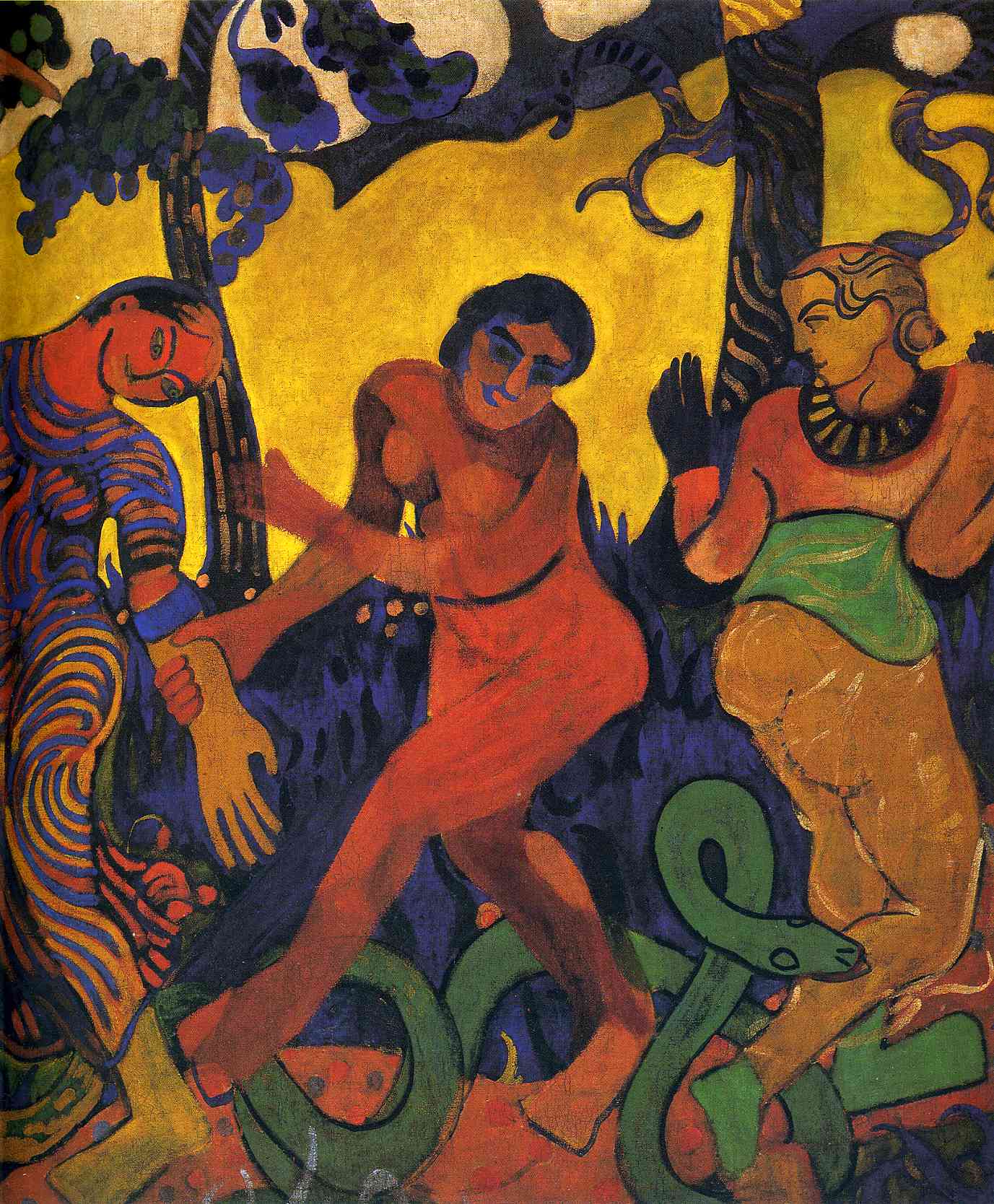
The Dance (Bathers)
Derain’s interpretation of the pastoral dance theme shows simplified, monumental figures entwined in a landscape of acidic greens and reds. The work recalls both Gauguin’s primitivism and Matisse’s contemporaneous Dance, yet Derain’s palette is more jarring, his forms more angular.
It marked a high point of his Fauvist exploration of the human figure before he turned toward Cézannian structure.
A bold synthesis of primitive art and modern color, it foreshadows the later Expressionist interest in ritual and emotional distortion.

Boats at Collioure
Painted alongside Matisse in the Catalan village of Collioure, this work captures the port with radical simplification: boats become patches of ultramarine, water is a field of pink and orange, and masts are reduced to rhythmic lines. The divisionist technique Derain employed dissolved form into pure sensation.
It was exhibited at the 1905 Salon d’Automne where critic Louis Vauxcelles labeled the artists “fauves” (wild beasts).
Derain applied unblended strokes of complementary colors to create maximum luminosity, a direct precursor to Orphism.
5 André Derain Prints, Museum Quality
Legacy: From Wild Beast to Modern Master
Derain’s direct influence is seen in Georges Braque’s early Fauvist landscapes before Cubism, and in the German Expressionist groups Die Brücke and Der Blaue Reiter, who embraced his radical color. In the 1910s, his turn toward a more structured classicism also influenced the “Return to Order” movement, inspiring artists like Pablo Picasso and Gino Severini to re-engage with tradition without abandoning modernity.
Institutions worldwide have honored Derain with major retrospectives: the Museum of Modern Art (1976), the Musée d’Art Moderne de la Ville de Paris (1994–95), and the Royal Academy of Arts (2017). His auction record continues to climb, with Arbres à Collioure selling for over $16 million in 2018, cementing his stature among early modern masters.
Today, Derain’s Fauvist paintings resonate with contemporary interior design: their bold palettes offer statement pieces for minimalist spaces, while his later landscapes bring a serene, classical harmony to living rooms. As framed art prints, they bridge the gap between art historical significance and everyday aesthetic pleasure.